What is Oral Language?
Oral language is the ability to understand and use spoken words to communicate. It is built on five domains: pragmatics, semantics, syntax, morphology, and phonology. Because oral language develops before children learn to read, it is one of the strongest predictors of later reading success, which is why it sits at the foundation of the Science of Reading.
The Five Domains of Oral Language:

Pragmatics
The social use of language in real communication

Semantics
The meaning of words and sentences, including vocabulary

Syntax
The rules for combining words into sentences

Morphology
The meaningful word parts, like prefixes, suffixes, and roots
Phonology
The sounds of language, down to individual phonemes
Why Oral Language Matters
for Literacy
The Science of Reading is clear: skilled reading grows out of language. The Simple View of Reading shows that reading comprehension depends on two things working together: decoding and language comprehension. The point is simple: language is language. Whether spoken or written, the goal is meaning, and the speaking and listening skills children build first become the reading and writing skills they draw on later.
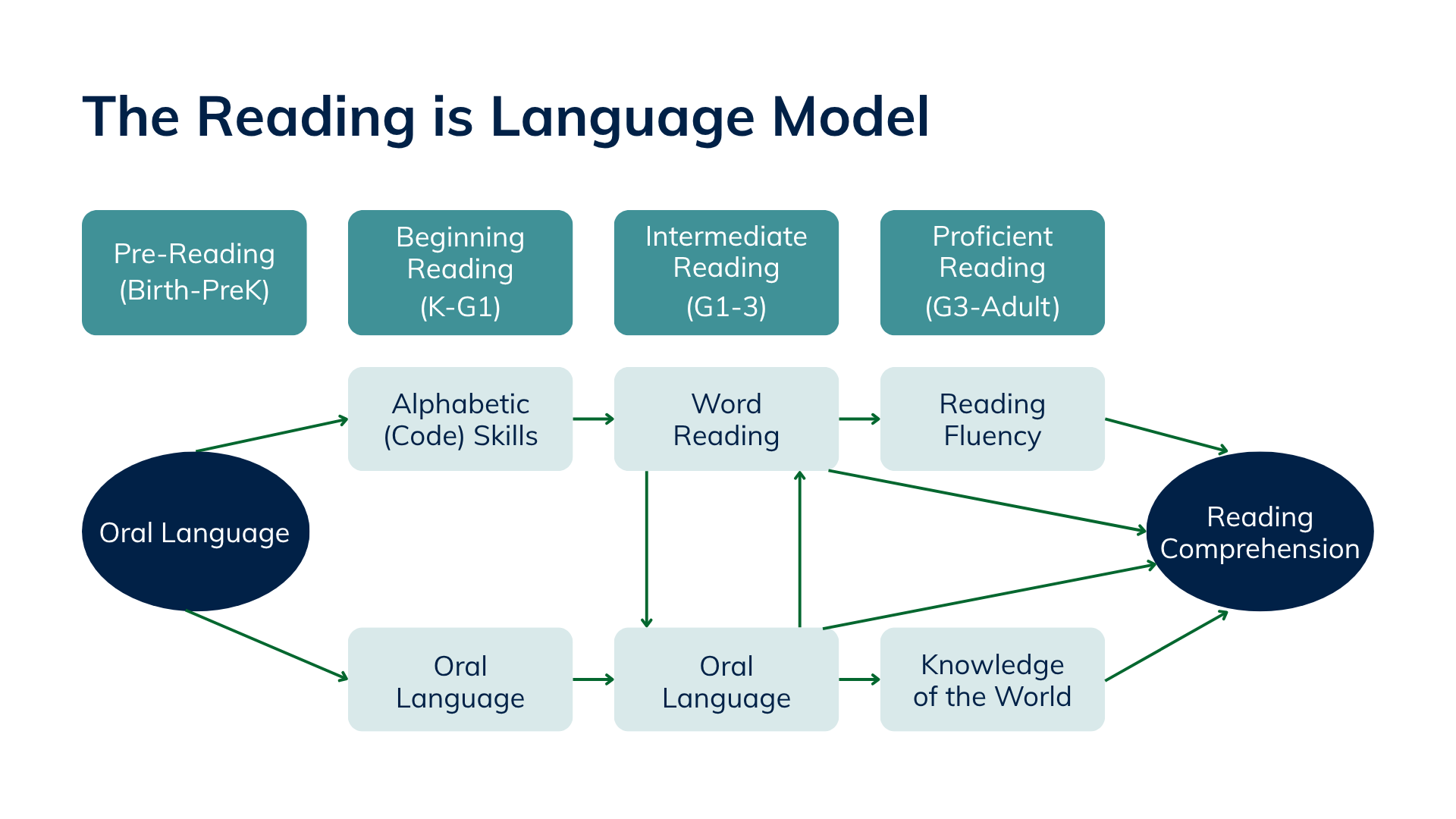
Source: Snowling and Hulme (2025). CC BY 4.0.
The Reading is Language Model (Snowling and Hulme, 2025) takes this a step further. It shows that early language skills are the foundation for both strands: decoding and comprehension. Oral language comes first, then feeds the growth of word reading and comprehension, which together make reading comprehension possible. Each stage depends on the language foundation laid before it.
But not every child arrives at school with the same language foundation. Differences in early language exposure can create gaps before formal reading instruction even begins. Explicit, intentional instruction that builds oral language skills helps close those gaps and gives every student a stronger start.
How language builds reading,
stage by stage
Early language skills drive the development of both word reading and later reading comprehension. The Reading is Language Model maps how this unfolds across four overlapping stages
Pre-Reading (Birth to PreK)
Before reading begins, oral language works purely as a tool for spoken communication. This is where the foundation is laid.
Beginning Reading (K to Grade 1)
Oral language supports the alphabetic (code) skills children pick up as they start school, such as phoneme awareness and letter-sound knowledge. At the same time, oral language continues to grow.
Intermediate Reading (Grades 1 to 3)
With code skills largely in place, students strengthen word reading. Here, word reading and oral language feed each other, with growth in one driving growth in the other.
Proficient Reading (Grade 3 to Adult)
Reading comprehension becomes firmly established. Word reading and oral language remain the primary drivers, with reading fluency and world knowledge as two additional influences.
Each stage builds on the language that came before it, which means the work of reading starts long before a child opens a book. Strengthen oral language early and you strengthen every stage that follows. That is where IMSE begins.
Language from the Start
Reading begins with language, so IMSE helps educators build it from the very first years of school. When teachers become teachers of language, every student gains a stronger foundation for reading, writing, and learning.
Our Pre-K Literacy Plus course equips early educators to nurture oral language from the ground up. It gives teachers the routines and knowledge to grow listening, speaking, and vocabulary, so young learners arrive at kindergarten ready to read. From there, IMSE's Orton-Gillingham Plus (OG+) approach connects spoken language to print through explicit, structured instruction, building the foundational skills students carry into every grade.
IMSE Resources to
Support Oral Language
IMSE goes beyond the curriculum. We are a long-term partner in your literacy journey, with resources to support oral language development at every stage.

Case Study: Sea of Sounds
See how a Brooklyn learning clinic built its programming on IMSE's OG+. Among 23 K-3 students with speech and language needs, mastery rose from 57% to 91%, with first graders gaining 51% in phonological awareness.
Read the Case Study

Sound Scenes
Engaging visual and auditory tools that develop phonological awareness and oral language. Educators use Sound Scenes to spark conversation, build vocabulary, and tune young ears to the sounds of language.
Explore Sound Scenes

Webinars
on Oral Language
Learn from literacy experts on your schedule. IMSE webinars cover oral language, structured literacy, and the strategies that make instruction stick.
Browse Webinars
More From the IMSE Blog
Dig deeper into oral language with expert insights, classroom strategies, and the latest research from the IMSE team.


Strengthen Oral Language: IMSE + OxEd
A powerful partnership for districts
IMSE has partnered with OxEd & Assessment to bring districts research-backed tools for identifying and building oral language, from early screening through whole-class instruction and intervention.
TEL Ted is OxEd's whole-class instruction and intervention resource. It gives educators structured, evidence-based support to strengthen oral language across the classroom, so no child falls behind before reading instruction begins.
Available to districts through IMSE. Connect with an IMSE National Account Executive to learn more.
Frequently Asked Questions
What are the five domains of oral language?
The five domains are phonology (the sounds of language), semantics (word meanings and vocabulary), syntax (how words form sentences), morphology (meaningful word parts like prefixes and suffixes), and pragmatics (how language is used socially). Together they give children the tools to understand and express meaning.
Why is oral language important for reading?
Oral language develops before children learn to read, and it is one of the strongest predictors of later reading success. Strong speaking and listening skills build the vocabulary, comprehension, and language structures that reading and writing depend on.
How is oral language connected to the Science of Reading?
The Science of Reading shows that skilled reading depends on word recognition and language comprehension working together. Oral language is the foundation for both word recognition and language comprehension, which is why it is essential to effective, evidence-based literacy instruction.
How can teachers support oral language in the classroom?
Teachers can build oral language through interactive read-alouds, structured discussions, rich questioning, and daily opportunities for students to speak and listen. In addition to explicit instruction, teachers can increase the quality of their talk to expose students to the kinds of more advanced words and sentence structures they will likely encounter in academic texts.
At what age does oral language develop?
Oral language begins developing at birth and grows rapidly through the early years, well before formal reading instruction. This makes early language exposure and intentional PreK and early-elementary instruction critical.
What is the difference between oral and written language?
Oral language is spoken and written language is written, but the goal of both is the same: to exchange ideas and information. In short, language is language. The skills children build through speaking and listening are the same ones they draw on to read and write.
Does oral language affect decoding, or just comprehension?
Both. While oral language clearly supports language comprehension, research behind the Reading is Language Model shows it also underpins decoding. Strong early language gives children the foundation for word reading and language comprehension, which ultimately leads to reading comprehension.